
Political anthropology and AI
Sixteen days' warning won't put out a wildfire
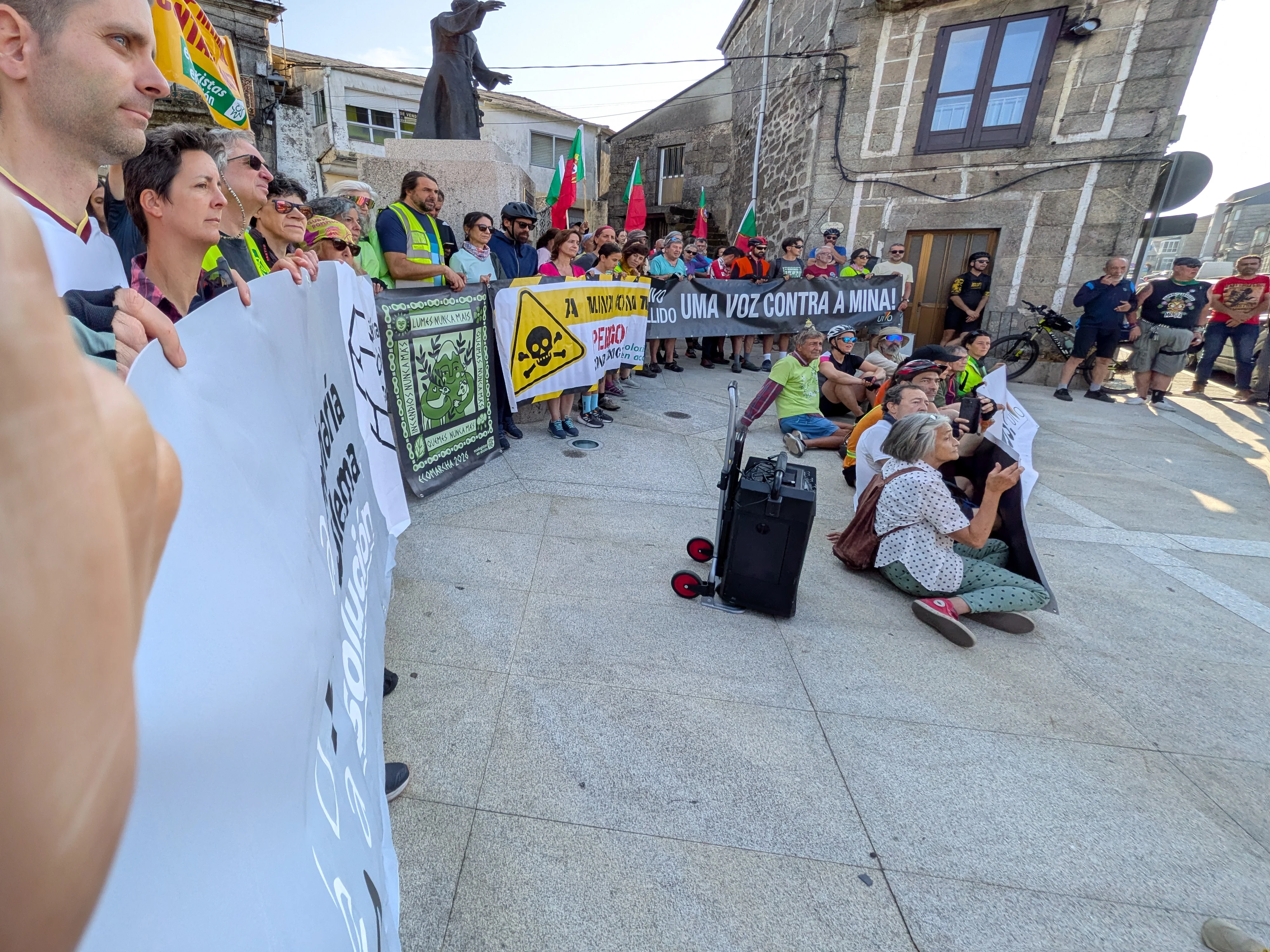
The 2026 Ecomarcha cycled through the burnt landscapes between León and Xixón. What its chronicles record, and what a predictive model cannot reconstruct on its own.
On 18 July 2026, Ecologistas en Acción’s Ecomarcha had not yet begun to pedal and the fire was already there.
The meeting point was Villaquilambre, on the outskirts of León. A few days earlier, a wildfire near Navatejera had forced the emergency level to be raised for several hours because of the proximity of homes and livestock farms. As evening fell, the group rode towards León to mark the start of the march. That same night, a group on its way back came across another small fire at the entrance to Navatejera and had to stop to alert the fire services. The chronicles recorded it as mal fario — a bad omen.
Over the following two weeks, the bicycles would pass through Molezuelas de la Carballeda, Sanabria, A Mezquita, Manzaneda, Valdeorras, Las Médulas, El Bierzo, Laciana and the Asturian valleys before reaching Xixón. The route had been deliberately designed to cross some of the areas affected by the major wildfires of 2025 and to meet the communities still living with their consequences. The public call announced more than 700 kilometres over fourteen stages; the internal chronicles that provide the main source for this note put the completed route at 660 kilometres.
Yet a bicycle route can hardly be reduced to a line on a map.
In Villalverde, when water runs low on a climb, someone brings out a garden hose to refill the bottles. In A Mezquita, a meeting at the Casa de Cultura brings the group together with the local council and with residents who, according to the chronicle, are mainly women describing how they lived through the previous summer’s fire. In Manzaneda, after a long stage, the village’s only shop opens outside its normal hours for those arriving. In Las Médulas, the coordinator of a rural project recounts how the fire entered a landscape recognised as a World Heritage Site.
These are tiny episodes set against tens of thousands of hectares burnt. That is precisely why they matter to anthropology.
Pedalling as method
The Chronicles of the 2026 Ecomarcha do not claim to be an academic ethnography. They are written from within by people who take part in the march, share many of its demands and are themselves part of what they describe. The chronicles explicitly acknowledge their purpose of preserving memories, locating them within the route and conveying something of the atmosphere that was experienced. That position does not make the material less interesting; it makes it situated.
They record conversations, hospitality, disagreements, accidents, local knowledge, transformations of the landscape, memories of work and different explanations of what makes a mountain burn. The observing body arrives tired, looks for shade, needs water, climbs a mountain pass and has to find somewhere to sleep.
Miguel Delibes grasped early on that relationship between movement and landscape. The bicycle was an important part of his biography. During his courtship with Ángeles de Castro, she gave him a typewriter and he gave her a bicycle. Mi querida bicicleta appeared in 1988; the following year, Mi vida al aire libre (Memorias deportivas de un hombre sedentario) brought together his memories of cycling and other outdoor pursuits. Writing and moving through the landscape became intertwined in a body of work that repeatedly returned to direct experience of the countryside and of the people who inhabit it.
Jorge Riechmann carried that materiality into the political realm. El socialismo puede llegar sólo en bicicleta was published in 2012 and appeared again in a revised and expanded edition in 2022. Asked about the title, he described the bicycle as “the ecosocialist artefact par excellence”. He did not use it as a symbol of technological rejection, but as a highly efficient industrial machine that greatly expands human mobility while using relatively little material and energy.
There is also a particularly suggestive geographical coincidence. In April 2023, Fabero’s Tierra, Cultura y Arte association invited Riechmann to speak about energy and ecological transitions and degrowth. Three years later, the same association would welcome the Ecomarcha in a former coal-mining district.
The Ecomarcha bicycle adds something to this genealogy. It sets a scale of observation. From a car, landscape can become distance. From a satellite, pixels. From a bicycle, gradients, springs, smells, shade, damaged roads, animals, shops, industrial ruins and conversations that force a stop come back into view.
The fire before the fire
In Matalobos del Páramo, the march visits an organic farm and then takes part in a meeting about León’s concejos vecinales. These are historical forms of local government that manage commons such as woodland, grazing land, water and heritage. The Federation of Minor Local Entities of León notes that the open concejo predates many present-day municipal structures as a form of government.
The next day, the landscape changes.
The group enters land burnt by the Molezuelas de la Carballeda fire and reaches Castrocontrigo. That afternoon, a person working in the Brigadas de Refuerzo en Incendios Forestales — the BRIF wildfire reinforcement brigades — and a forestry technician speak with those taking part in the march. According to the chronicles, they talk about prevention, available resources, working conditions and something much harder to represent on a map: local knowledge of the territory.
The BRIF are specialised units within Spain’s state wildfire response system, created to intervene in highly demanding situations and to be deployed wherever they are needed. MITECO maintains bases in areas crossed by or close to the route, including Tabuyo del Monte, Laza and Tineo.
Political ecology offers an especially useful framework for understanding why these conversations form part of the history of the fire. Dolors Comas d’Argemir argued that any account of the relationship between society and environment must incorporate unequal access to resources, the institutions that regulate their use, political factors, development models and the connection between local and global processes. Environmental degradation therefore ceases to appear as a simple imbalance in nature. It is also the outcome of particular social, political and economic relations.
“Land abandonment” describes a visible condition. It still leaves open the question of how that condition came about.
Changes in property, the disappearance of certain agricultural activities, transformations in livestock farming, access to services, ageing, precarious employment, management of commons and the material possibility of making a living from rural activity all belong to the landscape on which fire eventually acts.
The Ecomarcha encounters these layers almost by accident. In A Mezquita, it listens to residents who lived through the fire. A day later, in Manzaneda, it finds a different ecological and economic system. The soutos are chestnut groves, but they are also food, property, memory and work. There the group visits Amarelante, a cooperative founded in 2013 to recover abandoned chestnut groves and make them economically viable again. The cooperative itself describes its project as a tool for social transformation in the countryside.
In Galicia, moreover, the form of ownership itself complicates the phrase ‘land abandonment’. The montes veciñais en man común are a distinctive form of collectively held private property: they belong to neighbourhood communities as social groups, rather than to municipalities or individual quota-holders. The Xunta de Galicia records 3,312 classified commons covering 664,230 hectares, with 39.2% of them in the province of Ourense. Galician research on these commons has shown how their management ties together parish organisation, reciprocity, collective action and socio-economic change. Victoria Saco Lemos examined the relationship between communal mountain land and local society; Damián Copena has subsequently analysed these forms of collective governance and their social, economic and environmental challenges.
Later comes Terra en Pé Valdeorras, created after the 2025 fires and subsequently constituted as an association. During the weeks of the fires, more than a thousand people were at one point coordinating support work, according to its president in La Región.
In Ponferrada, Bierzo Aire Limpio and the Plataforma para la Defensa de la Cordillera Cantábrica add further layers. They speak about wildfire and biodiversity, but also pollution, industry, public management, restoration and the economic future of the mountains. The sequence reveals institutions that pre-date the fire and others that emerge afterwards.
A conversation that never took place
One of the smallest episodes in the chronicles may also be one of the most revealing.
The Ecomarcha enters Asturies over the Ventana pass and through Las Ubiñas-La Mesa Natural Park. In Quirós, a talk had been planned on “the value of scrub” in land management.
The talk never takes place.
According to the march’s account, the local council considers the debate ill-timed in the middle of a wave of wildfires. Ecoloxistes n’Aición d’Asturies decides to cancel the event so as not to increase tensions, while maintaining that the debate over land management remains necessary.
The scene reveals something that wildfire statistics struggle to register. After a catastrophe, there is also a struggle over how the catastrophe should be explained.
Scrub, grazing, burning, reforestation, forest management, rural abandonment and prevention can all acquire political and emotional meanings. A technically debatable hypothesis can become common sense. A necessary discussion can become socially unbearable only days after a fire.
An ethnography of wildfire also includes those conversations that never get to happen.
Sixteen days
The cancelled discussion in Quirós shows how difficult it is to debate the mountain while it is still burning. Three weeks after the route reached the Cantabrian coast, the University of León presented CROWNFIRE-AI in Ponferrada, a tool that does not need to debate: it calculates.
The system does not predict where a wildfire will start. It estimates something more specific. Using Sentinel-2 and MODIS imagery, information on vegetation, topography and meteorological data, it calculates the risk that, once a fire has begun, it will reach the crowns and spread through the forest canopy.
The model was trained on 18,874 plots from 33 major wildfires in Spain between 2017 and 2024. The Sentinel-2-based configuration achieved an overall accuracy of 90.15% in cross-validation and 91.25% when assessed against completely independent field data from the Sierra de la Culebra and Navalacruz fires. Forecasts from the GFS weather model can generate future maps up to a maximum of sixteen days ahead.
The researchers themselves qualify that horizon. Uncertainty in weather forecasts increases as the lead time grows; scenarios three or four days ahead are therefore of greater operational interest, while more distant periods should be treated as indicative and updated as new forecasts become available.
Barely a month earlier, Ponferrada had been one of the places where the group stopped to listen. It was now the setting in which a university presented a model designed to anticipate extreme fire behaviour.
CROWNFIRE compresses huge volumes of information in order to recognise a dangerous configuration before it occurs. The march does almost the opposite. It moves slowly and allows the landscape to unfold its history.
The model can estimate that a particular combination of moisture, vegetation, relief and weather favours a crown fire. On its own, it cannot reconstruct why that mountain now has that vegetation, which activities have disappeared from it, who owns the land, which institution manages it or what economic possibilities remain for continuing to live there.
That is not a defect of the algorithm. It defines its scale.
Sixteen days can be enormously valuable for deploying resources, intensifying surveillance or preparing emergency measures. But those sixteen days sit inside territorial transformations that may have begun decades earlier.
Prediction anticipates the conditions of the fire. Ethnography can reconstruct some of the conditions of the landscape.
The mines that remain after they close
The first mining episode comes early. In A Gudiña, on 23 July, the group encounters a protest by Ecoloxistas en Acción de Galiza and Portugal’s Movimento UIVO against a thirty-year extension of the San Xoán tungsten mine. More than a hundred people take part in the demonstration, and the organisations denounce the absence of a cross-border environmental assessment. In January, Santiago’s Court of First Instance and Preliminary Investigation No. 1 had opened proceedings to investigate an alleged offence of administrative misconduct connected with the granting of that extension, a case also reported by Europa Press.
Later, in Valdeorras and El Bierzo, come slate quarries and processing plants. And in Fabero, the Gran Corta, a former open-cast coal mine closed in 2018 whose restoration was still pending. The meeting with Tierra, Cultura y Arte brings together memories of labour, deindustrialisation and questions about the future of the district.
From those closed workings, it is difficult not to look towards the mines now being planned.
The International Energy Agency projects that, under its stated-policies scenario, aggregate demand for critical minerals will almost double by 2040, driven not only by electric vehicles, batteries and power grids, but also by high-tech manufacturing, digital systems and artificial intelligence itself.1
The European Union has turned that dependency into industrial policy. Regulation (EU) 2024/1252 — the Critical Raw Materials Act — sets 2030 benchmarks equivalent to 10% of EU needs being met through extraction within the Union, 40% through processing and 25% through recycling. In the Spanish legal version, the regulation uses materias primas fundamentales for critical raw materials and distinguishes within them a list of strategic raw materials.
Fabero can therefore be read not only as a ruin of the past but also as a warning in time. Every mine that opens simultaneously begins the history of its closure.
Michael Taussig showed in his ethnography of South American plantations and mines that a mining operation produces far more than mineral. In Bolivia’s tin mines he found labour relations, cosmologies, hierarchies and particular ways of understanding risk and the transformation of nature.
From Latin America, Maristella Svampa has described another level of the same process through the idea of the “Commodities Consensus”. Her argument concerns a historical and political context different from Europe’s, but it remains useful as an analytical warning. Extractive expansion does not distribute minerals and benefits alone. It also generates new asymmetries, territorial disputes and conflicts over which ways of valuing a place should prevail.
The comparison does not require us to claim that a Europe pursuing critical minerals will reproduce that trajectory exactly. It does allow one question to be asked.
What landscape will the transition of 2030 leave when viewed from 2070?
What grows among the ruins
Anna Tsing offers another temporality.
In The Mushroom at the End of the World, matsutake appears precisely in forests altered by human activity. It does not represent a return to untouched nature. The mushroom lives in disturbed landscapes and connects trees, soils, pickers, precarious labour, migration and international markets.
In Tsing’s account, ecology and history are not separate domains. Nor are nature and politics. Survival happens through associations among species, infrastructures, markets and forms of life that none of them fully controls.
Ruin is not the same as emptiness. When an operation ends, things continue to happen. Plants grow among buildings. Animals move through abandoned facilities. Occupational diseases and family memories persist. New uses, cooperatives or social movements appear. A former productive landscape may simultaneously become heritage, recreational space, ecological refuge, physical hazard or the site of another extractive project.
The Ecomarcha encounters all this without deliberately setting out to find a theory of ruins. It finds Fabero’s coal, the slate workings of Valdeorras, the recovered chestnut groves of Manzaneda, burnt forests, reservoirs, mining settlements and abandoned mountain land within the same journey.
Tsing helps to show what they have in common. Life can continue after extraction. That does not mean destruction has been repaired. The fact that a mushroom can live among ruins does not make the production of ruins acceptable.
The algorithm’s material web
Jason W. Moore uses the phrase “web of life” for a way of thinking that rejects a sharp separation between capitalism and nature. His world-ecology approach understands labour, energy, organisms, accumulation and territories as dimensions of the same historical process.
From that perspective, CROWNFIRE-AI also belongs materially to the landscape it observes. The algorithm needs satellites, sensors, data centres, electricity grids, electronic devices, scientific institutions and human labour. The whole system needs minerals.
The tool that represents a forest depends on other territories where copper, silicon and other materials needed to manufacture and power digital infrastructures are extracted.
The simple opposition between nature and technology therefore begins to lose its usefulness.
The bicycle is technology too.
The algorithm is territory too.
Reaching Xixón
The chronicles end beside the Cantabrian Sea.
Behind them lie hundreds of kilometres, mountain passes, falls, rivers, municipal sports halls, chestnut groves, former mines, wildfires, shared meals and encounters with local organisations.
The Ecomarcha’s own assessment resists turning the journey into an epic. The final assembly notes that there had been too little direct environmental action and that more effort should have been made to make the march visible in some of the places it crossed.
That observation matters. Ethnography must also register its own limits.
The Ecomarcha does not, by itself, explain wildfires. Nor does it demonstrate that the concejos, grazing, a cooperative or any particular model of prevention are sufficient answers. It produces something else: it makes visible a landscape populated by relationships that easily disappear when wildfire is reduced to hectares, temperatures, wind speeds and risk maps.
CROWNFIRE can gain up to sixteen days against a particular configuration of fire behaviour. For two weeks, the bicycles performed a different operation. They encountered decisions made decades earlier, commons still in use, closed mines that continue to reshape the landscape, chestnut groves being cultivated again, forestry work, environmental conflicts, local memories and communities that remain after the emergency crews have left.
The algorithm anticipates. The Ecomarcha reminds us that, before and after those sixteen days, someone still has to inhabit the territory.
Primary sources
- Ecologistas en Acción. Ecomarcha de verano 2026. ¡Incendios nunca más!. Official call.
- Ecologistas en Acción. Ecomarcha 2026: el ecologismo sobre ruedas recorre las tierras heridas por el fuego entre León y Xixón. 15 July 2026.
- Carlos Alonso. Crónicas de la Ecomarcha 2026. León–Xixón. ¡Incendios nunca más!. Internal working document, summer 2026. Main source for the scenes, encounters and route used in this note.
- University of León. CROWNFIRE-AI, la inteligencia artificial de la Universidad de León que anticipa el riesgo de que un incendio alcance las copas de los árboles. 24 August 2026.
- Fernández-Guisuraga, J. M. et al. CROWNFIRE-AI: Cloud-hosted software for estimating the risk of extreme crown wildfires using advanced remote sensing techniques and artificial intelligence. Ecological Informatics, 2026.
- Ecoloxistas en Acción de Galiza and Movimento UIVO. Activistas galegas e portuguesas ocupan a mina ilegal de San Xoán na Gudiña. 24 July 2026.
- Europa Press. Un juzgado de Santiago abre diligencias por posible prevaricación en la concesión de una mina en A Gudiña. 14 January 2026.
Institutional references and further reading
- Federación Leonesa de Entidades Locales Menores. La Federación Leonesa de Entidades Locales Menores.
- Xunta de Galicia, Consellería do Medio Rural. Os montes veciñais en man común e as súas mancomunidades.
- Saco Lemos, Victoria. “As comunidades de montes e a organización das parroquias: un estudio de caso”. Cooperativismo e economía social, no. 18, 1998, pp. 47–62.
- Copena Rodríguez, Damián. “Montes Veciñais en Man Común e Baldios: Unha análise comparativa das propiedades comunitarias de Galicia e Portugal”. Sémata. Ciencias Sociais e Humanidades, no. 30, 2018.
- Ministerio para la Transición Ecológica y el Reto Demográfico. Las Brigadas de Refuerzo en Incendios Forestales (BRIF) del Ministerio. See also Medios terrestres, which lists the bases at Tabuyo del Monte, Laza and Tineo.
- Amarelante Sociedade Cooperativa Galega. Proyecto.
- La Región. Terra en Pé Valdeorras se suma a la recuperación.
- Bierzo Aire Limpio. Afecciones a la biodiversidad de los incendios.
- Plataforma para la Defensa de la Cordillera Cantábrica. La Plataforma.
- Ecoloxistes n’Aición d’Asturies. Federación de Asturies.
- Fundación Miguel Delibes. Mi vida al aire libre. Includes bibliographical details for Mi querida bicicleta (Miñón, 1988) and Mi vida al aire libre (Destino, 1989).
- Riechmann, Jorge. El socialismo puede llegar sólo en bicicleta. Ensayos ecosocialistas. Los Libros de la Catarata, 2012; revised and expanded edition, 2022. See also Salvador López Arnal, interview with Jorge Riechmann, Papeles de relaciones ecosociales y cambio global, no. 119, 2012.
- Comas d’Argemir, Dolors. “Ecología política y antropología social”. Áreas. Revista Internacional de Ciencias Sociales, no. 19, pp. 79–99.
- Taussig, Michael T. The Devil and Commodity Fetishism in South America. University of North Carolina Press, 1980; thirtieth-anniversary edition, 2010.
- Svampa, Maristella. “Consenso de los Commodities y lenguajes de valoración en América Latina”. Nueva Sociedad, no. 244, 2013, pp. 30–46.
- Tsing, Anna Lowenhaupt. La seta del fin del mundo. Sobre la posibilidad de vida en las ruinas capitalistas. Capitán Swing, 2021; original US edition, The Mushroom at the End of the World, 2015.
- Moore, Jason W. El capitalismo en la trama de la vida. Ecología y acumulación de capital. Traficantes de Sueños, 2020; original edition, Capitalism in the Web of Life, Verso, 2015.
- International Energy Agency. Global Critical Minerals Outlook 2026. Paris, 2026. See especially the Outlook.
- European Union. Regulation (EU) 2024/1252 of the European Parliament and of the Council, 11 April 2024, establishing a framework for ensuring a secure and sustainable supply of critical raw materials.
- La Nueva Crónica. El profesor Riechmann visita Fabero para hablar de ecología. 2023.
Footnotes
-
According to the Global Critical Minerals Outlook 2026, lithium demand could grow by more than three times by 2040; demand for nickel, graphite and rare earths by between 50% and 90%; and copper demand by around seven million tonnes. ↩